

Area guide · The working town west of Puerto Banús
Property for Sale in San Pedro de Alcántara
A town founded in 1860 to grow sugar cane, with Roman baths at one end of its beach and a fifteen hundred year old basilica at the other. It was a working town long before it was an address.
Photograph: Bulevar San Pedro Alcántara, CC BY-SA 2.0
in San Pedro today
largest share of the market
colony was founded here
of the buried coast road
The place
A town with its own centre, not a resort with a name
San Pedro de Alcántara is the part of Marbella that was a town first. It sits west of Puerto Banús, between Nueva Andalucía and Guadalmina, and it has its own centre, its own church square, its own health centre and its own seat of local government. The tenencia de alcaldía on the Plaza de la Iglesia is the one that matters: San Pedro is a district of Marbella that is run from inside itself.
The centre stands about a mile back from the water, and for decades the coast road ran between the two. It does not any more. The road was put in a tunnel in 2012 and a boulevard of fifty five thousand square metres was built on the roof of it, which is why the town and its beach now read as one place rather than two.
This guide sets out how it came to be, what the street register says about who built it, what living here is actually like, and what the numbers say, including the running costs that no official body publishes and that we hold ourselves.

The bulevar from a top floor. Under the palms is the tunnel that carries the coast road, and the town runs down to the sea beyond it.
Where exactly it is
Between Guadalmina and Puerto Banús
The coast read west to east, from the mouth of the Guadalmina to the harbour at Puerto Banús. San Pedro sits between them with its centre set back from the water, the beach and its neighbourhoods in front of it, Cortijo Blanco to the east and the two halves of Guadalmina across the river to the west.

- 1San Pedro de AlcántaraThe town centre, about a mile back from the sea
- 2San Pedro PlayaThe beach and the beachside neighbourhoods, in front of the boulevard
- 3Cortijo BlancoThe low villa quarter east of the town, between San Pedro and Puerto Banús
- 4Guadalmina BajaWest across the river on the seaward side, the golf and the large plots
- 5Guadalmina AltaThe inland half of Guadalmina, above the A-7
- 6Vega del Mar basilicaThe 5th century basilica and its necropolis, in the eucalyptus
- 7Puerto BanúsTen minutes east along the promenade or the coast road
Orthophoto PNOA © Instituto Geográfico Nacional de España. Rotated so the area reads across the frame; the north mark keeps it honest. Pins mark the centre of each place, not a boundary.
The town was already here
A colony on the plain, then a town, then a coast
The same frame of coast, flown twice, seventy years apart. In 1956 the town is compact and set back from the water, with open ground between it and the sea. What fills that ground is most of what San Pedro sells today.


Nothing was added to these frames and nothing was moved. The only thing that changes is how much of the ground is spoken for. Historic and current imagery © Instituto Geográfico Nacional de España, both rendered through one frame at one scale.
How it came to be
Founded in 1860 to grow sugar, and it still works like a town
In 1860 Manuel Gutiérrez de la Concha e Irigoyen, first Marqués del Duero, created an agricultural colony on the plain between the Guadaiza and the Guadalmina. He gathered the most fertile land in the district into one estate and laid it out around the growing and milling of sugar cane, with the most modern machinery of the day and a model farm that trained the men who would run it. He named it twice over: for San Pedro de Alcántara, the Extremaduran saint his family was devoted to, and for his mother, Doña Petra de Alcántara Irigoyen.
There was industry here before the colony. The Trapiche de Guadaiza was built as a sugar factory in 1827, the first industrial building in San Pedro, a pre industrial mill whose gears were turned by the water of the river it takes its name from. In 1861 the Marqués put his model farm and his school for overseers on it. It was restored in 2015 and it is a cultural centre now, which is a better fate than most industrial buildings on this coast were given.
Two more survive. La Alcoholera turned the liquid left over from sugar into alcohol, six hundred and eighty square metres of tower and nave, and it is now a museum, an exhibition hall and a performing arts centre. The sugar and alcohol works that went with it gave the El Ingenio barrio its name, and the barrio is still called that. A town that names a neighbourhood after a sugar mill is a town that remembers what it was for.
The centre of it all is the Plaza de la Iglesia, and the two buildings on it are the point. The church the Marqués ordered was finished in 1866 and opened for worship on 22 August 1869, colonial in style, with a facade of three round arches under a tower and portico. It burned in 1936, reopened restored in 1943, and became a parish in its own right on 1 January 1944. Facing it is the Villa de San Luis, built at the end of 1880 by the family that took the colony on after him and bought by Marbella council in 1946. It is the administrative seat of the San Pedro district today. One square has held the church since 1866 and the town’s own town hall since 1946.

A house at Cortijo Blanco, an older villa next door. The stock here is mixed in a way the hillside addresses are not, and that is the point of the place.
An agricultural colony with its own church, model farm, sugar mill and alcohol works.
The Villa de San Luis on the Plaza de la Iglesia is the seat of the San Pedro district.
Living here
Built for February as well as August
The single most useful fact about living here is the least glamorous. San Pedro has a full health centre of its own, rebuilt by the Junta de Andalucía at a cost of 4.6 million euros into a building of five and a half thousand square metres over three floors. It took family medicine rooms from eleven to twenty four and added minor surgery, dentistry and mammography, and its reference hospital is Hospital Costa del Sol on the A-7. You are not driving into Marbella to see a doctor.
The schools work in both directions. Laude San Pedro International College is inside the town, at Urbanización Nueva Alcántara, teaching from two and a half to eighteen on both the British and the Spanish curriculum, with a community it puts at over sixty nationalities. The state schools are here too, in the town rather than out on a bypass, which is a different daily rhythm from the one most Marbella addresses offer.
Getting around is easier here than the map suggests. Puerto Banús is about ten minutes east and Marbella about fifteen, Estepona about twenty minutes west, and Málaga airport around three quarters of an hour. San Pedro also has the mountain road: the Ronda road comes down off the sierra and ends here, at its last kilometre, which puts Ronda and the Serranía within an hour. There is no train to Marbella, so a car is part of life.
The beach is fourteen hundred metres long and about thirty five metres wide, planted with eucalyptus and palms along the promenade, and it has held the Blue Flag for twenty four years along with the Q de Calidad. The promenade runs east from the mouth of the Río Guadaiza to Puerto Banús, and the ayuntamiento renewed fourteen hundred metres of railings along it in 2025. Behind it is the boulevard, which is where the coast road used to be.

San Pedro Playa, between the boulevard and the sand. Gardens, lamp posts and a path, which is most of what walkable means here.
Schools
Laude San Pedro International College in the town, ages 2.5 to 18, British and Spanish curriculum, over 60 nationalities.
Healthcare
A rebuilt health centre in the town with 24 family medicine rooms, minor surgery, dentistry and mammography; Hospital Costa del Sol for emergencies.
Getting about
Ten minutes to Puerto Banús, fifteen to Marbella, twenty to Estepona, about 45 to Málaga airport. The Ronda road ends here.
The beach
1,400 metres of sand about 35 metres wide, Blue Flag for 24 years, with the promenade running east to Puerto Banús.
What things cost
What is asked, and what was paid
Two numbers both get called “the price” here, and setting them side by side without saying which is which is how a guide contradicts itself. So they are kept apart. Registered sale prices are only published by postcode, and 29670 covers San Pedro together with Guadalmina, whose villas sit at the top of the range and pull the house figure up with them. The asking prices are San Pedro’s own.
Asking prices, per square metre
The bar is the middle half of what is being asked for each type in San Pedro de Alcántara right now, from the cheapest quarter to the dearest. The number in the row is the typical figure. Nothing here has necessarily sold at these prices; that is what the panel beside it is for.
Asking prices per built square metre, resale stock listed in San Pedro de Alcántara, 337 properties in total, as at 8 August 2026. From our own records.
What buyers actually paid
Every figure here is a registered deed price, the amount declared in front of a notary when the sale completed, for postcode 29670. Homes completed this year at a typical €4,358 per square metre, 7 per cent below Marbella as a whole. Houses went for €5,164 over an average 261 square metres, against €4,924 for a house in Marbella as a whole.
Read the two panels together and the lesson is the usual one: asking prices run over standing stock, which quietly accumulates every overpriced home that never sells, while deeds count only what traded. The gap between them is mostly that selection effect, not a discount waiting to be claimed.
- Postcode 29670, all homes€4,358564 deeds
- Postcode 29670, apartments€3,812429 deeds
- Postcode 29670, houses€5,164135 deeds
- Marbella, all homes€4,6654,037 deeds
- Marbella, houses€4,924776 deeds
JUST Real Estate analysis of registered deed prices, Portal Estadístico del Notariado, rolling 12 months, captured 15 August 2026. Postcode 29670 covers San Pedro together with Guadalmina. Prices are moving: the official house price index for Andalucía rose 4.1 per cent in the year to 2025 Q4 (INE); the index is not published below regional level.
What you can buy
The stock that actually exists here
for sale in San Pedro de Alcántara
41% of the stock
33% of the stock
9% of the stock
No official body publishes what is available to buy, only what has already sold, so this part comes from our own intelligence. Through our network memberships we see every resale property listed through an agency on this coast, which means we know both what is genuinely on the market in San Pedro de Alcántara and where the same home is being advertised more than once. This covers resale stock only, not new construction sold directly by developers.
The shape of what comes to market is what tells you San Pedro is a town rather than an estate. Apartments are the largest single share and houses are close behind, with penthouses and townhouses filling in around them, and a meaningful slice of what is listed is commercial rather than residential at all. That last part is unusual on this coast and it is the honest signal: places with shops for sale have shops. Very little raw land trades, because the colony’s plan filled the plain a long time ago.
- Apartments13841% of listings
- Houses and villas11033% of listings
- Penthouses299% of listings
- Townhouses144% of listings
Resale stock listed in San Pedro de Alcántara as at 8 August 2026, from our own records. Treat it as accurate to within five to ten per cent: a few near identical apartments in the same building are not always recognised as the same home when the sources are brought together.
Asking prices and supply as at 8 August 2026 · deed prices captured 15 August 2026 · refreshed each week
What it costs to own
The figure nobody official publishes
Every buyer eventually asks what a home here costs to hold, and no public body answers it. We can, because we record it. Across the San Pedro listings that publish their running costs, the median annual property tax, the IBI, is €958, and the median community charge is €1,536. Together that is €2,494 a year before utilities, garden and pool.
It is the lightest bill in this part of the coast and it is not close. Guadalmina, across the river, runs at €3,577 a year on the same measure, Nueva Andalucía at €4,400 and Puerto Banús at €5,052. The community charge is what moves the figure most. A town flat on a street carries nothing like the bill of an apartment inside a gated community with security, gardens and a shared pool, and the tax follows the size of the ground underneath.
None of that is a reason to hesitate anywhere else. It is a reason to know the number before you make an offer rather than after, and to have it in front of you when a seller’s agent tells you the fees are modest.
per year
per year
per year

From our own records, 157 listings publishing running costs, as at 8 August 2026.
San Pedro de Alcántara compared to nearby areas
The western ladder, in order
Five addresses share this end of the coast and they do not trade level. San Pedro is the only one of them that was a town before it was a market, and both the asking prices and the running costs show it.
| Address | Typical asking, per m² | Listed | Running costs, per year | Character |
|---|---|---|---|---|
| San Pedro de Alcántara | €5,464 | 109 | €2,494 | A working town with its own centre, church square and town hall |
| Guadalmina | €6,460 | 271 | €3,577 | Across the river, golf, large plots and the Roman baths |
| Puerto Banús | €8,704 | 63 | €5,052 | The harbour, ten minutes east along the front |
| Nueva Andalucía | €8,246 | 1542 | €4,400 | The golf valley behind, inland and greener |
| The New Golden Mile | €5,120 | 532 | €6,455 | West towards Estepona, newer and more of it |
Typical is the median asking price per built square metre for houses and villas listed in each area (apartments where an area has no villa stock) as at 8 August 2026; running costs are the median annual IBI plus community charge where enough listings publish them. From our own records.
San Pedro asks the least of the five for a house and is by a distance the cheapest of them to hold. On apartments the order changes and Guadalmina asks less per square metre, which is worth knowing before you read the table as a ranking. The reason San Pedro sits where it does is not that it is worse. It is that it is a town, so a good deal of its stock is ordinary housing rather than resort product. That is exactly what some buyers want and exactly what others do not, and which of the five is right for you is a conversation rather than a table.
Wider context: our guide to Marbella, area by area, and our property market data behind every figure on this page.
Who buys here
Three buyers, and what San Pedro de Alcántara gives each of them
The year-round home.
This is the case San Pedro makes best, and it is the reason people move here from further east. A health centre, schools, a church square and the district’s own town hall sit inside walking distance of each other, and none of it shuts in November. Very little of the year here depends on the season.
The holiday home that gets used.
The beach is fourteen hundred metres of it, the promenade runs from the Guadaiza all the way to Puerto Banús, and the boulevard gives you somewhere to be in the evening that is not a marina. For anyone who has owned nearer Banús and found the summer too loud, this is usually the answer.
The buyer watching the running costs.
San Pedro is the cheapest home to hold of every address in this part of the coast, by a wide margin, and it is not close. That is a durable advantage rather than a headline one, and it compounds over a long hold.
Common questions
Questions we are asked about property for sale in San Pedro de Alcántara
Is San Pedro de Alcántara part of Marbella?
Yes. San Pedro is one of the districts of the municipality of Marbella, and it has its own tenencia de alcaldía on the Plaza de la Iglesia, in the Villa de San Luis, along with its own citizen service office. It is administratively part of Marbella and functionally a town in its own right.
How far is San Pedro from Puerto Banús?
About ten minutes by car east along the coast road, and you can also walk or cycle it: the promenade runs from the mouth of the Río Guadaiza all the way to the harbour. Marbella is about fifteen minutes, Estepona about twenty in the other direction, and Málaga airport around three quarters of an hour.
What is the boulevard in San Pedro?
It is a park of fifty five thousand square metres built on the roof of the tunnel that carries the A-7 under the town. The road went underground in June 2012 and the boulevard opened on 12 December 2014, with eleven thousand square metres of green, four thousand of water, a nine hundred metre cycle lane and an amphitheatre.
What type of property for sale in San Pedro is most common?
It is genuinely mixed, which is unusual here. Of the 337 resale properties listed, 138 are apartments and 110 are houses, with 29 penthouses and 14 townhouses alongside them. That spread is what a town produces and an estate does not.
What does it cost to run a home in San Pedro?
Less than anywhere else at this end of the coast. Across the listings that publish their running costs, the median annual IBI is €958 and the median community charge €1,536, together €2,494 a year before utilities and garden. No official body publishes this figure. It comes from our own records.
What is there to see in San Pedro de Alcántara?
Two catalogued Roman and early Christian monuments, both free to visit and both open at weekends with guided visits. The Termas Romanas de Las Bóvedas at Guadalmina Baja are a second century bath building on an octagonal plan with seven vaulted rooms around a central core. The Basílica Paleocristiana de Vega del Mar is a fifth century church with two opposed apses, a form very rare in Spain, a baptistery pool cut as a lobed cross for baptism by immersion, and a necropolis of about two hundred graves.
For sale now
Current property for sale in San Pedro de Alcántara
10 properties for sale in San Pedro de Alcántara right now, from €640,000. What is here changes as listings come on and go off; for more detail on any home, or to arrange a viewing, get in touch with the team.

3 bedroom penthouse for sale in San Pedro de Alcantara
This is a contemporary residential development in San Pedro de Alcantara, within walking distance of the beach and the town's amenities. This top floor penthouse offers three bedrooms and two bathrooms across 104.4m2…
- 3 beds
- 2 baths
- Interior: 104.4 m²

3 bedroom ground floor apartment for sale in San Pedro de Alcantara
This is a contemporary residential development in San Pedro de Alcantara, within walking distance of the beach and the town's amenities. This ground floor apartment offers three bedrooms and two bathrooms across 93.7m…
- 3 beds
- 2 baths
- Interior: 93.7 m²

4 bedroom villa for sale in Cortijo Blanco, San Pedro de Alcantara
The largest plot of the seven detached villas in Cortijo Blanco, a flat, mature pocket of San Pedro de Alcantara that sits between Puerto Banus and the town centre. Four bedrooms and five bathrooms are spread over thr…
- 4 beds
- 5 baths
- Plot: 815.9 m²
- Interior: 396.59 m²

4 bedroom villa for sale in Cortijo Blanco, San Pedro de Alcantara
A detached villa in Cortijo Blanco, one of seven built to the same design across a flat, mature pocket of San Pedro de Alcantara that sits between Puerto Banus and the town centre. Four bedrooms and five bathrooms are…
- 4 beds
- 5 baths
- Plot: 812.71 m²
- Interior: 396.59 m²

3 bedroom penthouse for sale in Guadalmina Alta
A three bedroom penthouse on the top floor of block three, with more terrace than interior and the golf running away below the parapet. The scheme is a small gated community of thirty four apartments built on a shallo…
- 3 beds
- 2 baths
- Interior: 123.28 m²

2 bedroom apartment for sale in Guadalmina Alta
A two bedroom apartment on the second floor of block four, set back on the Guadalmina Alta ridge where the ground rises behind San Pedro and the golf runs out below. The scheme is a small gated community of thirty fou…
- 2 beds
- 2 baths
- Interior: 93.51 m²

3 bedroom penthouse for sale in San Pedro de Alcantara
A top floor apartment with more than seventy square metres of terrace, most of it open to the sky, on the fourth floor of the second building. The development sits a few streets back from the sea at San Pedro de Alcan…
- 3 beds
- 2 baths
- Interior: 116.68 m²

3 bedroom apartment for sale in San Pedro de Alcantara
A three bedroom apartment on the first floor of the second building, with a wide terrace off the living room and the whole of San Pedro's beachside strip within a short walk. The development sits a few streets back fr…
- 3 beds
- 2 baths
- Interior: 142.02 m²

4 bedroom town house for sale in San Pedro de Alcantara
This four-bedroom, three-bathroom townhouse forms part of Alcántara del Mar, a new development of 10 townhouses, 17 apartments and 6 commercial premises on Calle Pedro López Martos, on the beachside of the boulevard i…
- 4 beds
- 3 baths
- Interior: 290 m²
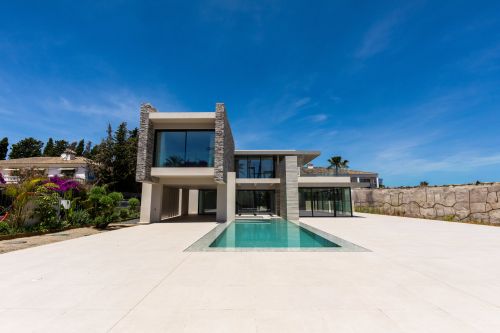
8 bedroom villa for sale in Cortijo Blanco, San Pedro de Alcantara
A new build villa in Cortijo Blanco, completing in 2026, its eight en suite bedrooms arranged across three levels a short walk from the beach. Cortijo Blanco sits on the beachside strip between San Pedro de Alcantara…
- 8 beds
- 8 baths
- Plot: 1,150 m²
- Interior: 880 m²

6 bedroom villa for sale in Guadalmina Baja, San Pedro de Alcantara
An exceptional opportunity to acquire a **brand-new contemporary villa in Guadalmina Baja**, one of Marbella’s most established and prestigious beachside residential areas. Currently under construction, this impressiv…
- 6 beds
- 6 baths
- Plot: 2,682 m²
- Interior: 1,069 m²

4 bedroom villa for sale in Cortijo Blanco, San Pedro de Alcantara
Beachside in San Pedro means something specific: flat ground, mature planting, and the promenade close enough to walk to before dinner. This house sits on a cul de sac in the middle of it. Cortijo Blanco is one of the…
- 4 beds
- 3 baths
- Plot: 840 m²
- Interior: 271 m²

3 bedroom duplex penthouse for sale in Nueva Alcantara
Located in one of the most exclusive and sought-after areas of San Pedro de Alcántara, this property enjoys a privileged setting just a short stroll from the new Boulevard and within walking distance of the beach. The…
- 3 beds
- 2 baths
- Interior: 94.5 m²

3 bedroom penthouse for sale in San Pedro de Alcantara
This exceptional property offers a refined lifestyle in the very heart of San Pedro, perfectly positioned next to the boulevard and surrounded by a full range of everyday services. Designed for those who value comfort…
- 3 beds
- 2 baths
- Interior: 12 m²

3 bedroom villa for sale in Guadalmina Alta, San Pedro de Alcantara
A two storey rustic villa in Guadalmina Alta, originally built in 1966 and renovated in 2024, its south facing plot of over two thousand square metres backing onto views of La Concha mountain. Guadalmina Alta sits inl…
- 3 beds
- 2 baths
- Plot: 2,163 m²
- Interior: 248 m²

5 bedroom villa for sale in San Pedro de Alcantara
With a focus on practicality, comfort, and modern style, this renovated villa delivers a living experience that feels equally suited to everyday life and extended holidays. From the moment you arrive, the home present…
- 5 beds
- 6 baths
- Plot: 800 m²
- Interior: 251 m²

3 bedroom apartment for sale in San Pedro de Alcantara
This new residential complex represents the beginning of a new way of living in Marbella and stands as the first residential development within the emerging district of Marbella West. More than simply a new address, i…
- 3 beds
- 3 baths
- Interior: 119 m²

3 bedroom apartment for sale in San Pedro de Alcantara
Breeze is an exclusive residential concept crafted for those who seek the essence of Mediterranean living in a setting defined by light, comfort, and contemporary elegance. This refined collection of just 34 apartment…
- 3 beds
- 4 baths
- Interior: 150 m²

4 bedroom villa for sale in San Pedro de Alcantara
Step into refined Mediterranean living with this stunning fully furnished villa, ideally situated just a short walk from the prestigious Guadalmina Golf Club and minutes from the beach. This exceptional property embod…
- 4 beds
- 5 baths
- Plot: 1,107 m²
- Interior: 320 m²
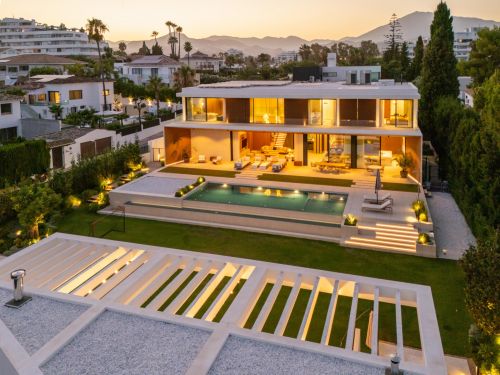
6 bedroom villa for sale in Guadalmina Alta, San Pedro de Alcantara
Guadalmina 720 epitomizes contemporary Marbella living, offering a sophisticated retreat for those who value style, comfort, and privacy. Located in the prestigious Guadalmina Alta area of San Pedro de Alcántara, this…
- 6 beds
- 7 baths
- Plot: 1,640 m²
- Interior: 1,057 m²

3 bedroom villa for sale in San Pedro de Alcantara
Located in the residential area of Alta Vista, strategically positioned between San Pedro de Alcántara and Guadalmina, this single-level villa offers a prime investment opportunity in one of Marbella’s most dynamic gr…
- 3 beds
- 2 baths
- Plot: 1,216 m²

2 bedroom duplex penthouse for sale in Nueva Alcantara
The property is located in one of the most sought-after areas of San Pedro de Alcantara, connected to the new boulevard and just a stone's throw from the beach. It is considered to be the most modern part of the city,…
- 2 beds
- 2 baths
- Interior: 125 m²

10 bedroom villa for sale in San Pedro de Alcantara
Nestled in the distinguished Guadalmina area, this villa stands as a monument to modern luxury and refined living. Just a stone’s throw from the renowned fairways of world-class golf courses and a mere breath away fro…
- 10 beds
- 10 baths
- Plot: 3,106 m²
- Interior: 992 m²

4 bedroom villa for sale in San Pedro de Alcantara
Seven bedrooms in one house is an argument in itself, and this villa makes it with a floor plan built for a household that spreads out rather than one that gathers in a single room, wings and levels giving every gener…
- 4 beds
- 4 baths
- Plot: 1,150 m²
- Interior: 515 m²
Free download
The Marbella Buyers Guide
Everything a buyer needs before the first viewing in San Pedro de Alcántara or anywhere else on the coast: the purchase process step by step, the taxes and fees, the checks that decide whether a property is sound, and how the market has actually been behaving.
- ProcessReservation, private contract, completion at the notary, and the timings between them.
- CostsTransfer tax, VAT on new build, notary, registry and legal fees, worked through on a real price.
- ChecksCadastre, land registry, planning status, community accounts and running costs.
Prefer to read it online? The buyers guide page. Every figure on this page sits in our property market data.

Talk to us
Tell us how you want to live at this end of the coast
San Pedro, Guadalmina and Nueva Andalucía are ten minutes apart and suit completely different people, and the difference is not only price. Tell us what the days should look like, and we will send you the streets that deliver it, with the honest drawbacks of each and the running costs in front of you before you view.
A person reads this and a person replies, usually the same day. No automated drip, no passing your details to another agency, and no obligation to view anything.
We have 25 years of experience in this market.
